Blog
Bladeless Fan Buying Guide: 10 Checks | GM Modular
Updated on Jul 2026
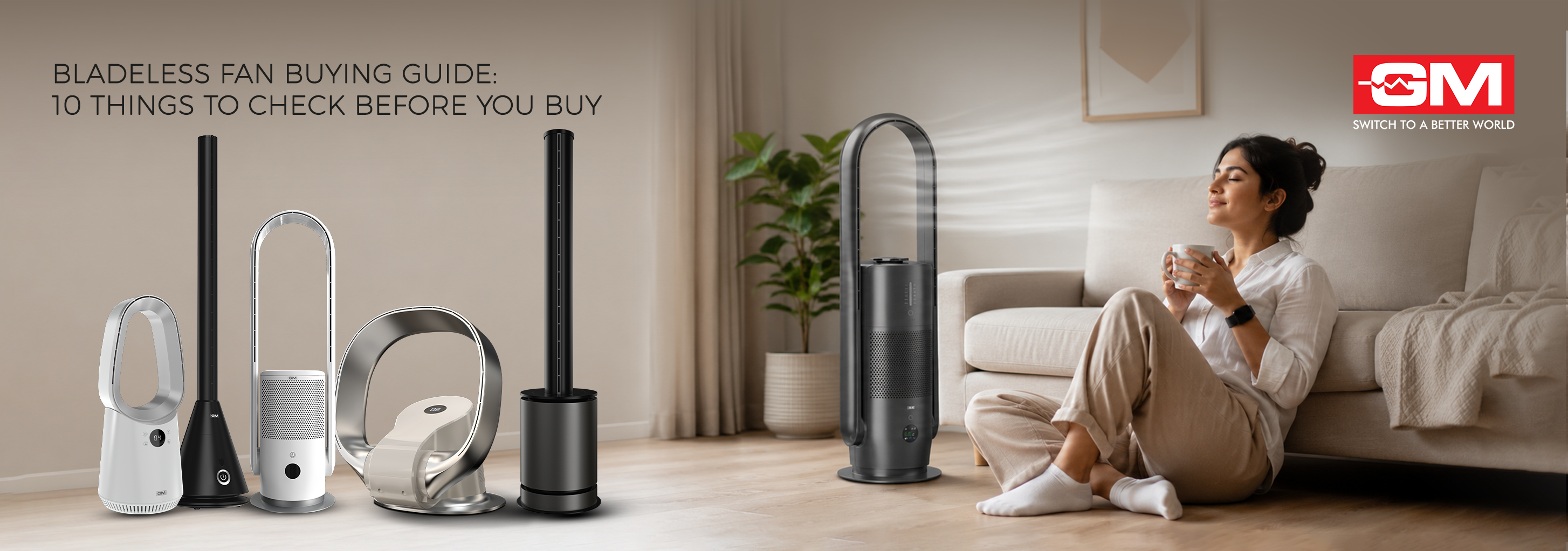
Bladeless Fan Buying Guide: 10 Things to Check Before You Buy
A bladeless fan looks like the obvious upgrade. No spinning blades, a slim tower, a quiet hum, and a price that hints it must be the better choice. But the word “bladeless” on the box tells you almost nothing about whether the fan will cool your room, sip electricity, or suit a home with toddlers. A bladeless fan is only the right buy when its numbers match your space and how you use it. Here are the 10 things to check before you pay.
How a Bladeless Fan Actually Works (in 30 Seconds)
Here’s the first surprise: a bladeless fan is not truly bladeless. The blades sit hidden inside the base, out of sight and out of reach. A brushless motor pulls air into the base, speeds it through a narrow slot, and sends it out around a hollow ring.
As the air leaves the ring, it pulls the surrounding air along with it, creating a stronger stream than the motor alone produces (a physics effect called inducement and entrainment). That’s why the breeze feels smooth and steady instead of choppy, and why the air you feel can be several times more than the motor pulls in. Keep this in mind, because it explains most of the checks below.
10 Things to Check Before You Buy a Bladeless Fan
1. Real airflow, not just one number. Don’t judge airflow by a single figure on the box. The label often shows CFM (Cubic Feet per Minute), which measures the air moving at the vent, but a bladeless fan then amplifies that stream by pulling in surrounding air, often 3 to 5 times the original. So, a modest figure can still fill a room if the multiplier is high. Where you can, check both the motor rating and the effective output, then match them to your room size.
2. Motor type and wattage. A BLDC (Brushless Direct Current) motor typically uses 30 to 40 per cent less electricity than an older induction motor at the same airflow and gives you finer speed control. Check the actual wattage on the box, because a bladeless shape does not guarantee an efficient motor.
3. The energy-rating reality. India has no BEE (Bureau of Energy Efficiency) star rating for bladeless fans yet, so you cannot lean on a star label the way you would with a ceiling fan. That means wattage becomes your most useful comparison. Some bladeless models draw around 141 watts, nearly double a conventional fan’s 75 watts or so, so read the wattage figure closely before you decide.
4. Noise level in decibels. A well-made bladeless fan typically runs between 30 and 45 dB, and the quietest settings can drop to 20 to 25 dB. For bedrooms, nurseries, or study areas, aim below 50 dB. Anything higher tends to creep into sleep and concentration.
5. Oscillation angle and coverage. A narrow 70 to 90-degree swing suits a single seat. Wider arcs spread air across a whole room. The GM Modular Artic Wind bladeless fan, for example, offers 80-degree vertical and 45-degree horizontal oscillation, which helps it reach more corners of the space.
6. Air purification and filter cost. Many bladeless fans double as purifiers. The GM Modular OxyAir bladeless fan uses a HEPA filter that captures up to 99.95 per cent of particles, plus UV sterilisation and a built-in air-quality sensor. One thing buyers forget: those filters need periodic replacement, so budget for that small running cost.
7. Smart controls and convenience. Look for the features you will actually use, not the longest spec list. The Artic Wind offers Wi-Fi and voice control with a 9-speed BLDC motor, while the OxyAir adds four modes (Sleep, Max, Auto, Natural) and an off-timer of up to 8 hours. A remote and a good timer often matter more day to day than a dozen speeds.
8. Safety beyond “no visible blades”. Bladeless fans are genuinely safer, but the detail still matters. On some floor-standing towers, the outlet slot is wide enough for small fingers. If you have young children, check that aperture, or pick a wall or ceiling-mounted model that stays out of reach.
9. Space, form, and mounting. Slim vertical towers tuck into compact flats without eating floor space. Decide upfront whether you want a floor tower, a bladeless desk fan for a work surface, or a wall-mounted unit. The Artic Wind, for instance, works as either a table or wall fan, which is handy in a smaller room.
10. Warranty, build, and price. Check the warranty length and build quality before you pay, and weigh the price against the features you will genuinely use rather than the spec sheet alone. The Artic Wind, for instance, is backed by a 25-month warranty. A longer warranty usually signals the brand’s own confidence in the product.
Also Read: What are BLDC Fans? Advantages & Disadvantages Explained
Setting the Right Expectation
One thing worth knowing before you buy: a bladeless fan cools you, not the room. Like any fan, it creates a wind-chill effect that can make you feel roughly 2 to 4 degrees C cooler, but it does not drop the actual room temperature the way an air conditioner does. Keep that in mind, and you will enjoy the comfort without expecting more than a fan can give. Actual comfort and savings may vary based on usage and room conditions.
Buying a bladeless fan comes down to reading the numbers, not the styling. If a fan delivers good airflow, quiet operation, efficient power use, and the features your family will genuinely use, you’ve likely found one worth buying. Match those checks to your room and your daily use, and the sleek design becomes a welcome bonus. If you plan to buy bladeless fan models online, compare options that balance efficiency, safety, and smart features, and explore the GM Modular range when you shop for a bladeless fan online.
Frequently Asked Questions
1. What is a bladeless fan and how does it work?
A bladeless fan hides its blades in the base, where a motor draws in air and pushes it out through a ring. The moving stream pulls surrounding air along with it, creating a smooth, steady breeze without any exposed spinning blades.
2. What decides the bladeless fan price in India?
A bladeless fan's price depends on airflow, motor type, air purification, and smart features, so a purifying model with a BLDC motor costs more than a basic one. Compare features against your needs, and check current pricing on the retailer's or GM Modular’s product page before you buy.
3. Is a bladeless fan more energy-efficient than a normal fan?
Not always. Efficiency comes from the motor, not the shape. A BLDC model can save power, but some bladeless fans actually draw more watts than a conventional fan, so always check the wattage before buying.
4. Which is the best bladeless fan for a bedroom?
For a bedroom, look for a quiet model running below 50 dB with a timer and gentle low speeds. A purifying option such as the GM OxyAir also helps keep the air cleaner while you sleep.
5. What makes a GM bladeless fan a good choice?
GM Modular bladeless fans, such as the Artic Wind and OxyAir, pair BLDC efficiency with smart controls and air purification, plus a sturdy build and multi-year warranty. That mix gives you comfort, safety, and everyday convenience in one unit.
Related Blogs
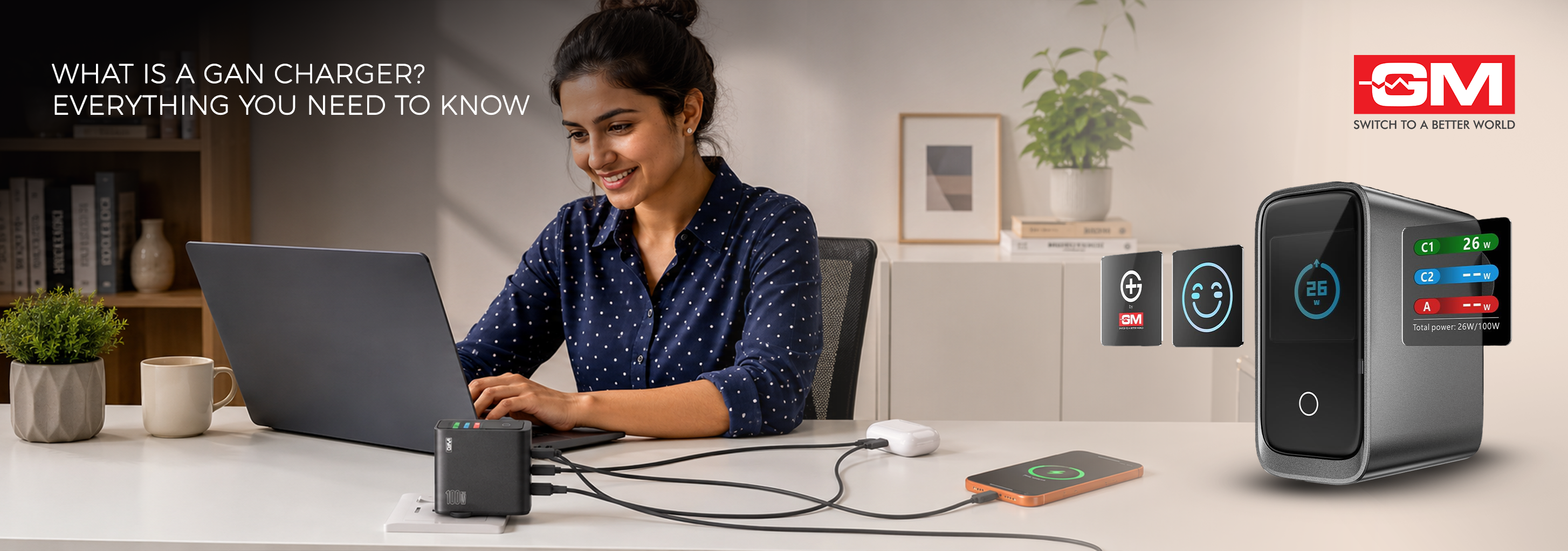
What Is a GaN Charger? A Simple Guide
What Is a GaN Charger? Everything You Need to Know You have probably used gallium nitride for years without knowing it. Before it reached the charger on your wall, this material lit up the first white LEDs, powered blue lasers, and read the discs in
Read More
GM Artic Air 1: 3-in-1 Bladeless Tower Fan
Why the GM Artic Air 1 Is the Ultimate 3-in-1 Appliance for Every Season Picture one slim tower in the corner of your living room. In May, it cools you through a brutal afternoon. In August, it clears the damp, stale air the monsoon leaves beh
Read More
Wireless Charging vs Wired Charging: Which Is Faster?
Wireless Charging vs Wired Charging: Which Is Faster? If your phone is at 10% and you have twenty minutes before heading out, which charger should you grab: the cable or the pad? Wireless charging is everywhere now, yet most of us still reach for a
Read More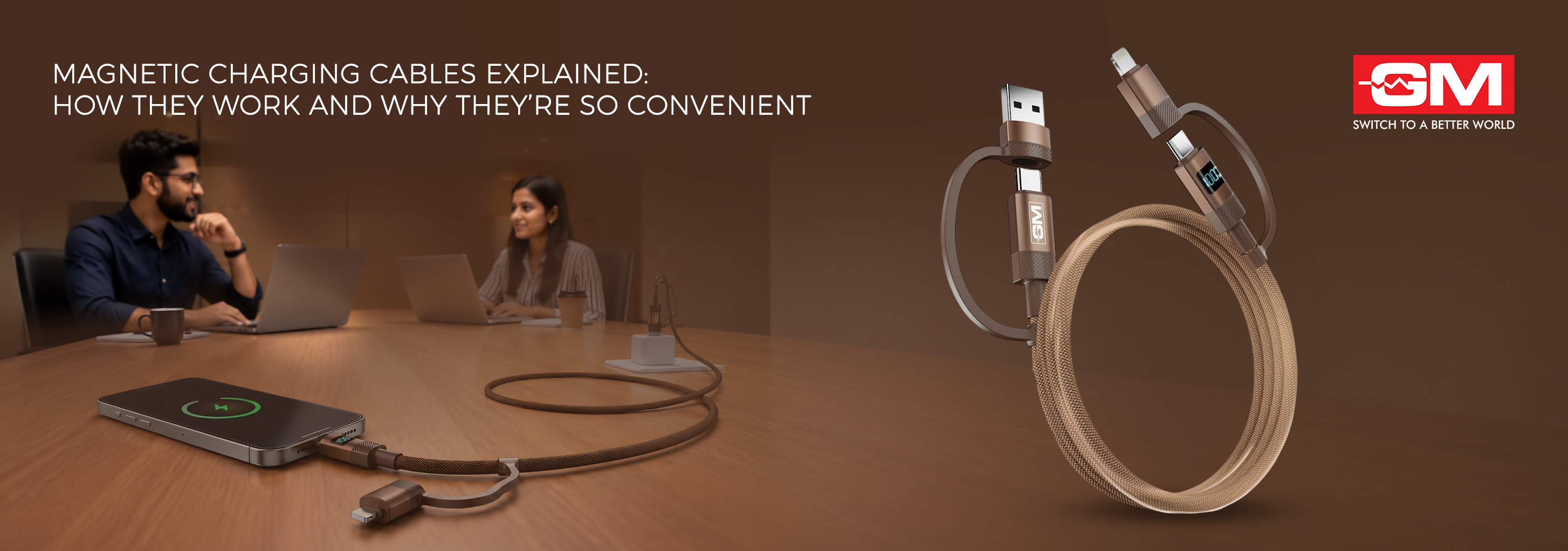
Magnetic Charging Cables Explained
Magnetic Charging Cables Explained: How They Work and Why They’re So Convenient We’ve all felt it. The cable that only charges at one odd angle, the frayed neck near the plug, and the port that no longer grips the connector properly. Mos
Read More