Blog
Magnetic Charging Cables Explained
Updated on Jul 2026
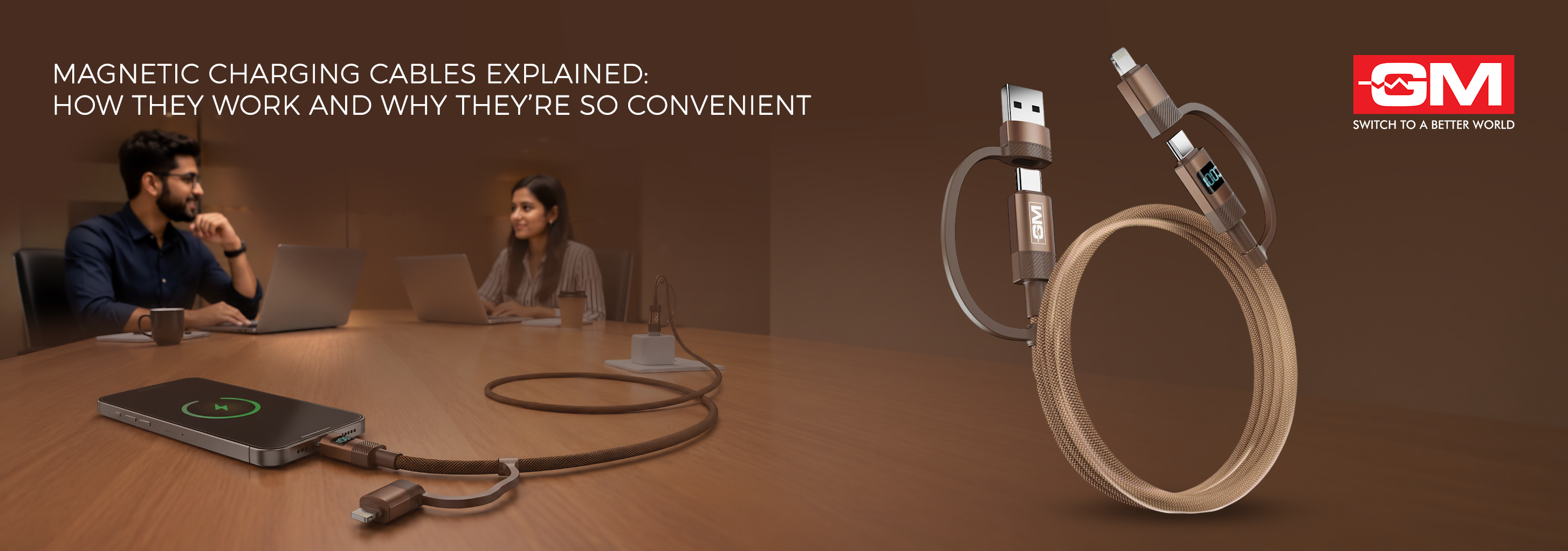
Magnetic Charging Cables Explained: How They Work and Why They’re So Convenient
We’ve all felt it. The cable that only charges at one odd angle, the frayed neck near the plug, and the port that no longer grips the connector properly. Most of us blame the cable. Often, though, the real casualty is the charging port on your phone or laptop. This is the problem magnetic charging cables were built to solve, and once you see how they work, it becomes clear why more homes are switching to them.
What Is a Magnetic Charging Cable?
A magnetic charging cable is really two parts, not one. A small tip sits inside your device’s charging port and stays there. The main cable then snaps onto that tip with magnets, so you never push a connector into your phone again. You just bring the cable close and let it link up.
There are two common designs. Some use a detachable tip you can move between devices; others have a fixed magnetic head. A detachable magnetic phone charger cable gives you flexibility across gadgets, while a built-in design is simpler to look after.
How Do Magnetic Charging Cables Work?
Here’s the clever bit. A magnetic USB cable separates the electrical connection from the act of plugging in. The tip inside your port holds tiny spring-loaded contacts called pogo pins. When the magnetic end of the cable meets the tip, those pins line up and touch, and power flows across the contact. Most consumer cables use one to five pins, depending on how much power and data they need to carry.
The magnets are usually neodymium, a strong permanent magnet. They pull the two halves into position on their own, so the cable aligns itself even when your aim is off. That’s why connecting one in the dark takes no effort at all.
Wired Magnetic Cables vs Wireless Magnetic Charging
This is where buyers often get muddled, so it’s worth settling. A wired magnetic cable moves electricity through physical pins, exactly as described above. Wireless magnetic charging, such as MagSafe or the Qi2 standard, works differently: magnets only align two coils, and power then crosses a small gap by induction, with no pins ever touching.
Put simply, a magnetic USB charger that clicks onto a tip is a wired cable. The pad your phone rests on is wireless. Both rely on magnets, yet only one passes power through direct metal contact. Getting this distinction right saves you from buying the wrong thing for your device.
Why Magnetic Charging Cables Are So Convenient
The satisfying snap gets the attention. The bigger benefit is quieter, and it protects your device’s port. USB-C and Micro USB ports are rated for a limited number of insertion cycles, usually around 10,000 under the USB standard. Charge two or three times a day, and that count drops faster than you’d think; a worn port is awkward and expensive to repair.
A magnetic setup moves nearly all that wear onto the small tip, which costs little and can be replaced. The port built into your expensive device stays untouched. Add one-handed connection, far less fraying at the neck, and tangle-free storage, and the appeal turns properly practical.
Also Read: GM Modular TravelEase Pro Universal Travel Adapter: Features & Benefits
How to Choose the Best Magnetic Charging Cable
Choosing the best magnetic charging cable comes down to matching it to how you charge. A few factors matter most:
-
Power delivery: Check the wattage. A 100W cable can handle laptops and tablets, not only phones. Keep in mind that fast charging needs the whole chain to cooperate, so a high-wattage cable on a low-wattage adapter charges only as fast as the weakest part allows.
-
Data support: Some cables charge but do not transfer data. If you sync files, confirm the data speed in the specifications.
-
Build quality: A braided jacket and reinforced connectors outlast a plain plastic cable by a wide margin.
-
Compatibility: For a home mixing Android, iOS, and laptops, check that the connectors and tips suit all of them.
GM Modular offers a range that maps neatly to these needs. The G+ Air Magnetic 100W C-C Cable, with an ultra-thin 4.5mm flat body and magnetic auto-wrap, suits everyday carry and a tidy desk. The G+ Flash PD 100W Magnetic Cable is a sensible pick for charging a phone and a laptop over USB-C. For heavier work, the G+ USB 4 Gen-III Magnetic Cable supports up to 240W, 40Gbps data, and even 8K video through one cable.
A Quick Safety Note
As with any charging accessory, a little care goes a long way. Use a good-quality cable with a suitable adapter, and steer clear of unbranded options that skip safety protections. Follow the manufacturer’s guidelines, and if a cable is damaged or runs hot, stop using it. These simple habits typically keep both your devices and your home safe.
Magnetic charging cables are more than a neat trick. By shifting daily wear onto a cheap, replaceable tip, they protect the one part of your device you cannot easily fix: its charging port. Once you know how they work, the convenience makes sense. If you want to simplify charging at home, explore GM Modular’s range of magnetic cables and match one to your devices.
Frequently Asked Questions
1. What are magnetic charging cables and how do they work?
Magnetic charging cables use a small tip that stays in your device’s port and a cable that snaps onto it with magnets. Spring-loaded pins inside the tip carry power once the magnets pull the two halves into alignment.
2. Are magnetic charging cables safe for my phone?
Yes, when you pick a quality cable and a suitable adapter. A good magnetic phone charger cable actually reduces port wear by removing repeated plugging. Avoid uncertified cables, as they may lack basic safety protections.
3. Can a magnetic USB cable transfer data as well as charge?
Some can and some cannot. Charging-only cables exist alongside models that also sync data. Always check the stated data speed in the specifications before buying if file transfer matters to you.
4. Do magnetic charging cables support fast charging?
Many do, but fast charging depends on the cable, the adapter, and your device working together. A 100W cable on a low-wattage adapter will still charge slowly, so match all three parts for the best speed.
5. Which is the best magnetic charging cable for a home with many devices?
Look for a 100W USB-C cable with data support and a sturdy build. GM Modular’s G+ Flash and G+ Air magnetic cables cover common phone, tablet, and laptop needs with a single, tidy connection.
Related Blogs

Bladeless Fan Buying Guide: 10 Checks | GM Modular
Bladeless Fan Buying Guide: 10 Things to Check Before You Buy A bladeless fan looks like the obvious upgrade. No spinning blades, a slim tower, a quiet hum, and a price that hints it must be the better choice. But the word “bladeless” on
Read More
What Is a GaN Charger? A Simple Guide
What Is a GaN Charger? Everything You Need to Know You have probably used gallium nitride for years without knowing it. Before it reached the charger on your wall, this material lit up the first white LEDs, powered blue lasers, and read the discs in
Read More
GM Artic Air 1: 3-in-1 Bladeless Tower Fan
Why the GM Artic Air 1 Is the Ultimate 3-in-1 Appliance for Every Season Picture one slim tower in the corner of your living room. In May, it cools you through a brutal afternoon. In August, it clears the damp, stale air the monsoon leaves beh
Read More
Wireless Charging vs Wired Charging: Which Is Faster?
Wireless Charging vs Wired Charging: Which Is Faster? If your phone is at 10% and you have twenty minutes before heading out, which charger should you grab: the cable or the pad? Wireless charging is everywhere now, yet most of us still reach for a
Read More