Blog
What Is a GaN Charger? A Simple Guide
Updated on Jul 2026
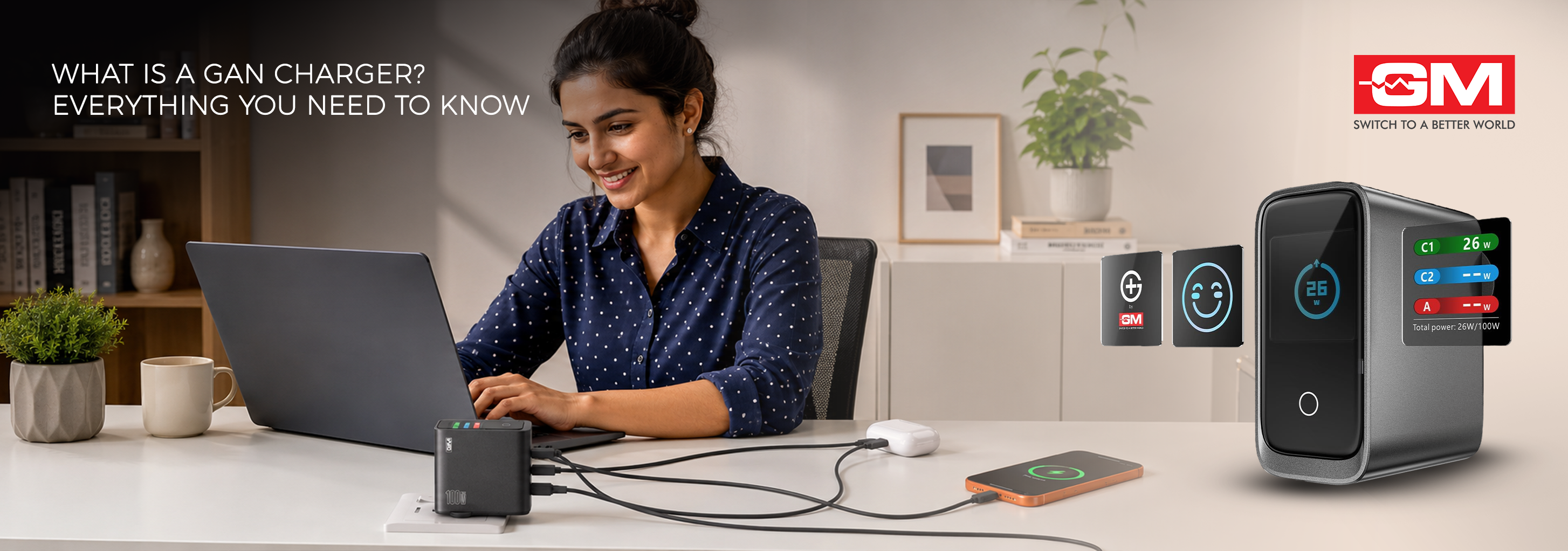
What Is a GaN Charger? Everything You Need to Know
You have probably used gallium nitride for years without knowing it. Before it reached the charger on your wall, this material lit up the first white LEDs, powered blue lasers, and read the discs inside Blu-ray players. So a GaN charger is not a brand-new gimmick; it is a proven technology that has quietly moved into everyday charging. So, what is GaN technology charger, how does it work, and does it belong in your home? Here is everything you need to know.
What Is a GaN Charger?
A GaN charger is a charger that uses gallium nitride (a semiconductor material) in place of traditional silicon inside its circuitry. Silicon has powered chargers for decades and works perfectly well, but it has limits. It generates more heat, wastes more energy, and needs more physical space to run safely.
Gallium nitride handles electricity more efficiently. It can cope with higher voltages and higher temperatures than silicon, which lets a gallium nitride charger stay compact while still delivering plenty of power. That is why it can be smaller yet just as capable as a bulkier unit.
How Does a GaN Charger Work?
Every charger has one core job. It converts the alternating current (AC) from your wall socket into the direct current (DC) your devices actually use. With silicon, a fair share of that energy is lost as heat during conversion. Gallium nitride does the same job while wasting far less.
The clever part is switching speed. Gallium nitride switches on and off at much higher frequencies, which shrinks bulky internal parts like transformers and coils. Smaller parts mean a smaller charger. Many high-quality GaN chargers can achieve conversion efficiencies above 95%, which typically means less wasted energy, less heat, and a body around half the size of an equivalent silicon unit.
GaN Charger vs a Normal Charger
So how does it compare to the charger bundled in most boxes? The differences are practical, not just technical.
The takeaway: A GaN charger gives you more charging power in a smaller, cooler package, which is why many brands are moving away from silicon designs.
Key Benefits of GaN Chargers
For a home juggling several gadgets, the advantages add up quickly:
-
Compact and travel-friendly, so one small unit can replace a bulky adapter in your bag.
-
Cooler operation, since less wasted energy means less heat for both charger and device.
-
Faster charging on supported devices, thanks to standards like USB Power Delivery (PD) and Quick Charge (QC).
-
Multi-device charging, powering a phone, tablet, and earbuds from a single unit.
-
Less energy waste, as efficient conversion means more power reaches your device.
Also Read: Best GM Modular Extension Boards for Safe & Convenient Power Usage
Not Every Fast Charger Is a GaN Charger
Here is a common mix-up worth clearing up. “GaN” describes the material inside the charger, while “fast charging” describes a standard like PD or Quick Charge. Many fast chargers still use silicon, so a fast charger is not automatically a GaN charger. The two often go together, yet they are not the same thing.
One safety myth is also worth retiring. A higher-wattage GaN charger will not force too much power into a small device. A good GaN charger negotiates with whatever you plug in, so a 100W unit simply delivers the roughly 25W your phone asks for.
How to Choose the Right GaN Charger in India
With plenty of options on the shelf, the right choice comes down to matching the charger to your devices and your home. Work through these checks:
-
Match the wattage. Phones typically need 18 to 45W, tablets 30 to 45W, and laptops 65 to 140W. Pick one that meets your most power-hungry device.
-
Check the fast-charging standard. Look for USB Power Delivery (PD 3.0 or 3.1) and PPS support. PD 3.1 can handle up to 240W for demanding laptops.
-
Count the ports. For several devices at once, a two to four port model beats a single-port one. Many multi-port chargers share their total power across ports, so check the manufacturer’s distribution details before charging two high-power gadgets.
-
Mind the cable. Use a USB-C cable rated for your charger’s wattage. An older or lower-rated cable can limit charging speed.
-
Verify certification. In India, look for the BIS mark, and ideally CE and RoHS compliance, which confirm it has been tested for electrical safety.
-
Consider Indian conditions. With voltage fluctuation common in many areas, built-in protection against overvoltage, overcurrent, overheating, and short circuits matters. One compact charger also suits real routines, whether that is a work-from-home desk, a student carrying a single charger to college, or less clutter near the TV unit.
GM Modular’s G+ GaN Chargers
This is where GM Modular, India’s trusted name in electrical solutions, offers a practical option. Its G+ range brings gallium nitride technology into everyday charging with built-in safeguards, with a model to suit different users:
-
The G+ 20W Dual Port GaN Adaptor is a lightweight, budget-friendly pick for everyday phone users and easy travel.
-
The G+ 25W GaN Fast Charger is a compact single-port USB-C option for faster charging of newer smartphones and tablets, with smart power allocation and an LED indicator.
-
The G+ 33W Dual Port GaN Adaptor adds a second port using Type-A and Type-C, making it handy for couples, students, and travellers who charge two devices at once.
Each model includes protection against overvoltage, overcurrent, and overheating. As always, use any charger according to the manufacturer’s guidelines for safe, reliable use.
Smaller, cooler, faster, and more efficient, a GaN charger solves everyday frustrations we once accepted with older chargers. Once you know what a GaN charger is, and how to match wattage, standard, and certification to your devices, choosing one becomes easy. If you are buying today, GaN is no longer a premium novelty; it is becoming the smarter long-term choice for anyone charging several modern devices. To bring it home safely, explore GM Modular’s G+ range of GaN chargers.
Frequently Asked Questions
1. What is a GaN charger, and what is a gallium nitride charger?
They are the same thing. A GaN charger, or gallium nitride charger, uses gallium nitride instead of silicon inside its circuitry. This lets it handle power more efficiently, so it can be smaller, cooler, and faster than a traditional charger.
2. Is a GaN charger safe for my phone?
Yes. A quality GaN charger negotiates the correct power with your device, so it only supplies what your phone needs. Look for built-in protections and a BIS mark, as offered on GM Modular’s G+ chargers, for peace of mind.
3. Is a 100W GaN charger safe for a small device?
Yes. A GaN charger with Power Delivery adjusts its output automatically, so a 100W model delivers only the wattage a small device requests. It will not force its full power into a phone that needs far less.
4. What is GaN charger technology, and how does it differ from PD?
GaN charger technology refers to the gallium nitride material inside the charger, while Power Delivery (PD) is the fast-charging standard it uses. The best chargers combine both for quick, safe charging.
5. Can one GaN charger power a phone, tablet, and laptop?
Often, yes. A multi-port GaN charger can charge several devices at once, though the total power is shared across the ports. Choose a charger with enough overall wattage for your devices, not just enough ports.
What Is a GaN Charger? Everything You Need to Know
You have probably used gallium nitride for years without knowing it. Before it reached the charger on your wall, this material lit up the first white LEDs, powered blue lasers, and read the discs inside Blu-ray players. So a GaN charger is not a brand-new gimmick; it is a proven technology that has quietly moved into everyday charging. So, what is GaN technology charger, how does it work, and does it belong in your home? Here is everything you need to know.
What Is a GaN Charger?
A GaN charger is a charger that uses gallium nitride (a semiconductor material) in place of traditional silicon inside its circuitry. Silicon has powered chargers for decades and works perfectly well, but it has limits. It generates more heat, wastes more energy, and needs more physical space to run safely.
Gallium nitride handles electricity more efficiently. It can cope with higher voltages and higher temperatures than silicon, which lets a gallium nitride charger stay compact while still delivering plenty of power. That is why it can be smaller yet just as capable as a bulkier unit.
How Does a GaN Charger Work?
Every charger has one core job. It converts the alternating current (AC) from your wall socket into the direct current (DC) your devices actually use. With silicon, a fair share of that energy is lost as heat during conversion. Gallium nitride does the same job while wasting far less.
The clever part is switching speed. Gallium nitride switches on and off at much higher frequencies, which shrinks bulky internal parts like transformers and coils. Smaller parts mean a smaller charger. Many high-quality GaN chargers can achieve conversion efficiencies above 95%, which typically means less wasted energy, less heat, and a body around half the size of an equivalent silicon unit.
GaN Charger vs a Normal Charger
So how does it compare to the charger bundled in most boxes? The differences are practical, not just technical.
The takeaway: A GaN charger gives you more charging power in a smaller, cooler package, which is why many brands are moving away from silicon designs.
Key Benefits of GaN Chargers
For a home juggling several gadgets, the advantages add up quickly:
-
Compact and travel-friendly, so one small unit can replace a bulky adapter in your bag.
-
Cooler operation, since less wasted energy means less heat for both charger and device.
-
Faster charging on supported devices, thanks to standards like USB Power Delivery (PD) and Quick Charge (QC).
-
Multi-device charging, powering a phone, tablet, and earbuds from a single unit.
-
Less energy waste, as efficient conversion means more power reaches your device.
Also Read: Best GM Modular Extension Boards for Safe & Convenient Power Usage
Not Every Fast Charger Is a GaN Charger
Here is a common mix-up worth clearing up. “GaN” describes the material inside the charger, while “fast charging” describes a standard like PD or Quick Charge. Many fast chargers still use silicon, so a fast charger is not automatically a GaN charger. The two often go together, yet they are not the same thing.
One safety myth is also worth retiring. A higher-wattage GaN charger will not force too much power into a small device. A good GaN charger negotiates with whatever you plug in, so a 100W unit simply delivers the roughly 25W your phone asks for.
How to Choose the Right GaN Charger in India
With plenty of options on the shelf, the right choice comes down to matching the charger to your devices and your home. Work through these checks:
-
Match the wattage. Phones typically need 18 to 45W, tablets 30 to 45W, and laptops 65 to 140W. Pick one that meets your most power-hungry device.
-
Check the fast-charging standard. Look for USB Power Delivery (PD 3.0 or 3.1) and PPS support. PD 3.1 can handle up to 240W for demanding laptops.
-
Count the ports. For several devices at once, a two to four port model beats a single-port one. Many multi-port chargers share their total power across ports, so check the manufacturer’s distribution details before charging two high-power gadgets.
-
Mind the cable. Use a USB-C cable rated for your charger’s wattage. An older or lower-rated cable can limit charging speed.
-
Verify certification. In India, look for the BIS mark, and ideally CE and RoHS compliance, which confirm it has been tested for electrical safety.
-
Consider Indian conditions. With voltage fluctuation common in many areas, built-in protection against overvoltage, overcurrent, overheating, and short circuits matters. One compact charger also suits real routines, whether that is a work-from-home desk, a student carrying a single charger to college, or less clutter near the TV unit.
GM Modular’s G+ GaN Chargers
This is where GM Modular, India’s trusted name in electrical solutions, offers a practical option. Its G+ range brings gallium nitride technology into everyday charging with built-in safeguards, with a model to suit different users:
-
The G+ 20W Dual Port GaN Adaptor is a lightweight, budget-friendly pick for everyday phone users and easy travel.
-
The G+ 25W GaN Fast Charger is a compact single-port USB-C option for faster charging of newer smartphones and tablets, with smart power allocation and an LED indicator.
-
The G+ 33W Dual Port GaN Adaptor adds a second port using Type-A and Type-C, making it handy for couples, students, and travellers who charge two devices at once.
Each model includes protection against overvoltage, overcurrent, and overheating. As always, use any charger according to the manufacturer’s guidelines for safe, reliable use.
Smaller, cooler, faster, and more efficient, a GaN charger solves everyday frustrations we once accepted with older chargers. Once you know what a GaN charger is, and how to match wattage, standard, and certification to your devices, choosing one becomes easy. If you are buying today, GaN is no longer a premium novelty; it is becoming the smarter long-term choice for anyone charging several modern devices. To bring it home safely, explore GM Modular’s G+ range of GaN chargers.
Frequently Asked Questions
1. What is a GaN charger, and what is a gallium nitride charger?
They are the same thing. A GaN charger, or gallium nitride charger, uses gallium nitride instead of silicon inside its circuitry. This lets it handle power more efficiently, so it can be smaller, cooler, and faster than a traditional charger.
2. Is a GaN charger safe for my phone?
Yes. A quality GaN charger negotiates the correct power with your device, so it only supplies what your phone needs. Look for built-in protections and a BIS mark, as offered on GM Modular’s G+ chargers, for peace of mind.
3. Is a 100W GaN charger safe for a small device?
Yes. A GaN charger with Power Delivery adjusts its output automatically, so a 100W model delivers only the wattage a small device requests. It will not force its full power into a phone that needs far less.
4. What is GaN charger technology, and how does it differ from PD?
GaN charger technology refers to the gallium nitride material inside the charger, while Power Delivery (PD) is the fast-charging standard it uses. The best chargers combine both for quick, safe charging.
5. Can one GaN charger power a phone, tablet, and laptop?
Often, yes. A multi-port GaN charger can charge several devices at once, though the total power is shared across the ports. Choose a charger with enough overall wattage for your devices, not just enough ports.
Related Blogs

Bladeless Fan Buying Guide: 10 Checks | GM Modular
Bladeless Fan Buying Guide: 10 Things to Check Before You Buy A bladeless fan looks like the obvious upgrade. No spinning blades, a slim tower, a quiet hum, and a price that hints it must be the better choice. But the word “bladeless” on
Read More
GM Artic Air 1: 3-in-1 Bladeless Tower Fan
Why the GM Artic Air 1 Is the Ultimate 3-in-1 Appliance for Every Season Picture one slim tower in the corner of your living room. In May, it cools you through a brutal afternoon. In August, it clears the damp, stale air the monsoon leaves beh
Read More
Wireless Charging vs Wired Charging: Which Is Faster?
Wireless Charging vs Wired Charging: Which Is Faster? If your phone is at 10% and you have twenty minutes before heading out, which charger should you grab: the cable or the pad? Wireless charging is everywhere now, yet most of us still reach for a
Read More
Magnetic Charging Cables Explained
Magnetic Charging Cables Explained: How They Work and Why They’re So Convenient We’ve all felt it. The cable that only charges at one odd angle, the frayed neck near the plug, and the port that no longer grips the connector properly. Mos
Read More