Blog
What Causes an MCB to Trip Repeatedly and How to Fix It?
Updated on Jun 2026
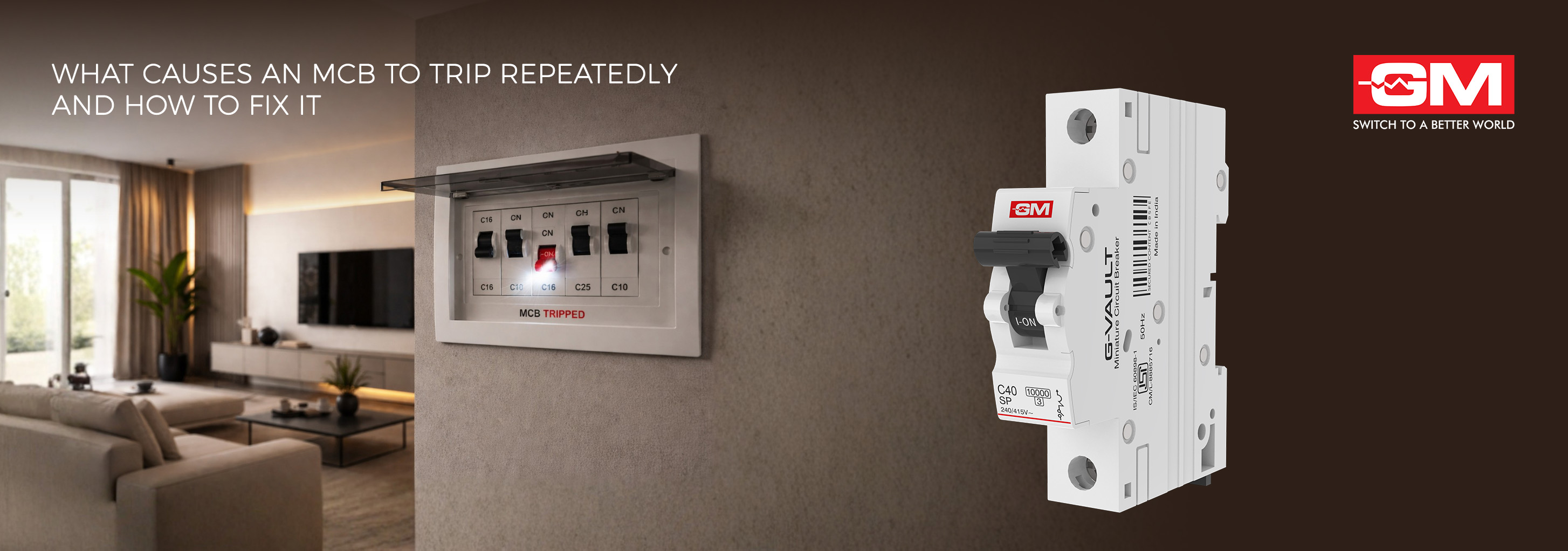
If your MCB just tripped again and you’re wondering whether it’s a simple overload or something dangerous inside your walls, don’t worry. In most cases, the fix is straightforward. Knowing why MCB is tripping helps you identify the cause quickly and restore safe power to your home. This guide covers the common causes, a step-by-step diagnosis, and the fixes you need.
Quick Diagnosis: Identify Your Problem First
-
Trips after heavy use (AC, geyser, microwave running together): likely an overload
-
Trips instantly (with a spark or burning smell): likely a short circuit; do not reset
-
Trips randomly, even without heavy appliances: likely a ground fault, faulty appliance, or worn-out breaker
Understanding the Basics: Why Do MCB Trips?
An MCB (Miniature Circuit Breaker) is an automated safety device in your home’s electrical panel. Its job is to protect your wiring from damage, overheating, and fires. When it detects abnormal current flow, it cuts the power instantly.
Here’s the key point: a trip is not a fault. It’s a successful defence mechanism. To understand why the MCB trips, you need to know about two internal mechanisms:
-
Thermal mechanism: A bimetallic strip inside the MCB bends when excessive heat from a sustained overload builds up, triggering the trip.
-
Magnetic mechanism: An electromagnetic coil reacts instantly to the massive surge caused by a short circuit, tripping the breaker in milliseconds.
To learn more, read our detailed guide on how a miniature circuit breaker works.
The Primary Reasons Why MCB is Tripping Repeatedly
If your breaker keeps cutting out, one of three electrical faults is almost certainly responsible. The table below helps you match your symptoms to the likely cause.
Here’s what each fault type means for your home:
-
Overload: The most common reason for MCB trip events in Indian homes. Picture a typical summer evening: you switch on the AC, someone starts the microwave, and the geyser is already running. That single circuit can’t handle all three, so the breaker cuts the power.
-
Short circuit: This occurs when a live wire comes into direct contact with a neutral wire, creating a dangerous surge. If you notice a burning smell or sparks near an outlet the moment the breaker trips, a short circuit is the likely cause.
-
Ground fault: This occurs when a live wire touches an earthed metal surface or water. It’s especially common in kitchens and bathrooms during the monsoon season.
This is why MCB trips again and again in many homes, when multiple high-wattage appliances run simultaneously. A modern, precisely calibrated breaker can reduce these nuisance trips significantly. GM Modular MCBs are designed to distinguish normal surges from genuine faults, keeping your home protected without unnecessary interruptions.
How to Troubleshoot a Persistent MCB Tripping Issue
Once you recognise the type of fault, you can safely begin the diagnostic process. Follow these steps to isolate the cause of your MCB tripping issue:
-
Switch off all appliances connected to the affected circuit. Unplug them from the wall sockets completely.
-
Reset the breaker. Push the MCB lever firmly back to the “ON” position. If it holds steady, the circuit itself is likely fine.
-
Reconnect appliances one at a time. Wait a few minutes between each one. The appliance that causes the breaker to trip again is your culprit.
-
Check for visible damage. Inspect the power cord of the faulty appliance for fraying, discolouration, or melted plastic.
-
Assess the circuit. If the breaker trips even with zero appliances connected, the MCB tripping problem is likely inside the wall wiring itself. Stop testing immediately and call a licensed electrician.
For homes with older electrical panels, a well-segmented distribution board makes diagnosis far easier. GM Modular Distribution Boards isolate each room or appliance group on its own circuit, helping you contain faults quickly.
Also Read: The Importance of MCB in Electrical Safety
Identifying a Worn-Out Breaker: Reason for MCB Tripping
If you’ve tested the circuit and every appliance checks out fine, the reason for the MCB tripping could be the breaker itself. MCBs are mechanical devices with a limited operational lifespan.
Over time, the internal bimetallic strip (the thermal mechanism that detects overloads) can weaken due to:
-
Repeated tripping events that wear down the metal
-
Previous severe electrical surges that damaged internal components
-
Simple old age, especially in breakers installed over a decade ago
A degraded breaker may trip at currents well below its rated capacity, causing constant false alarms. In such cases, replacing the old unit with a modern, precisely engineered breaker is the safest solution. For added protection against ground faults and electric shock, consider pairing your new MCB with GM Modular RCCBs (Residual Current Circuit Breakers).
Also Read: What Is a Short Circuit? Causes, Dangers, and Prevention Tips
Critical Electrical Safety and Replacement Rules
Always turn off the main power supply before attempting to inspect any distribution board or breaker. If unsure about any step, consult a qualified electrician immediately.
Key safety rules to follow:
-
Never use tape or objects to force a tripping MCB to stay “ON”. This bypasses a critical safety mechanism and can cause electrical fires.
-
Never repeatedly reset a breaker that trips instantly. An immediate trip signals a severe short circuit or ground fault that requires professional attention.
-
Always call a licensed electrician if you suspect wiring damage inside the walls or smell burning near your electrical panel.
Most MCB trips are easy to identify and fix once you understand why the MCB is tripping. Whether it’s a simple overload or a sign of deeper wiring trouble, the key is to diagnose calmly and act safely. For reliable, long-term protection, GM Modular’s range of MCBs, RCCBs, and distribution boards is engineered to keep your home safe. Explore the complete GM Modular home protection range for peace of mind.
Frequently Asked Questions
1. Why is MCB tripping every time I turn on my air conditioner?
Air conditioners draw a large initial surge of power. If your circuit is already under heavy load, this extra surge can overload the system and trigger the MCB. Try running the AC on a dedicated circuit.
2. Why do MCBs trip immediately after I reset them?
An immediate trip typically indicates a severe short circuit or ground fault in the wiring. Don’t attempt to reset it repeatedly. Call a certified electrician to locate and repair the fault safely.
3. Is occasional MCB tripping dangerous for my home?
An occasional trip from an accidental overload is normal. However, if MCB tripping happens frequently, it could signal degraded wires, a faulty appliance, or a failing breaker that needs replacement.
4. What is the most common reason for MCB trip events in kitchens?
Kitchens have high-wattage appliances such as microwaves, kettles, and toasters. Running several simultaneously on a single circuit is the leading reason for MCB trip events in this area.
5. How do GM Modular protective devices resolve a chronic MCB tripping issue?
GM Modular devices feature highly calibrated trip mechanisms that distinguish between harmless minor surges and genuine faults. This helps prevent nuisance trips while ensuring maximum safety for your home.
Related Blogs

Bladeless Fan Buying Guide: 10 Checks | GM Modular
Bladeless Fan Buying Guide: 10 Things to Check Before You Buy A bladeless fan looks like the obvious upgrade. No spinning blades, a slim tower, a quiet hum, and a price that hints it must be the better choice. But the word “bladeless” on
Read More
What Is a GaN Charger? A Simple Guide
What Is a GaN Charger? Everything You Need to Know You have probably used gallium nitride for years without knowing it. Before it reached the charger on your wall, this material lit up the first white LEDs, powered blue lasers, and read the discs in
Read More
GM Artic Air 1: 3-in-1 Bladeless Tower Fan
Why the GM Artic Air 1 Is the Ultimate 3-in-1 Appliance for Every Season Picture one slim tower in the corner of your living room. In May, it cools you through a brutal afternoon. In August, it clears the damp, stale air the monsoon leaves beh
Read More
Wireless Charging vs Wired Charging: Which Is Faster?
Wireless Charging vs Wired Charging: Which Is Faster? If your phone is at 10% and you have twenty minutes before heading out, which charger should you grab: the cable or the pad? Wireless charging is everywhere now, yet most of us still reach for a
Read More