Blog
Ceiling Fan Buying Guide (2026): Things You Need to Know Before You Buy
Updated on Jun 2026
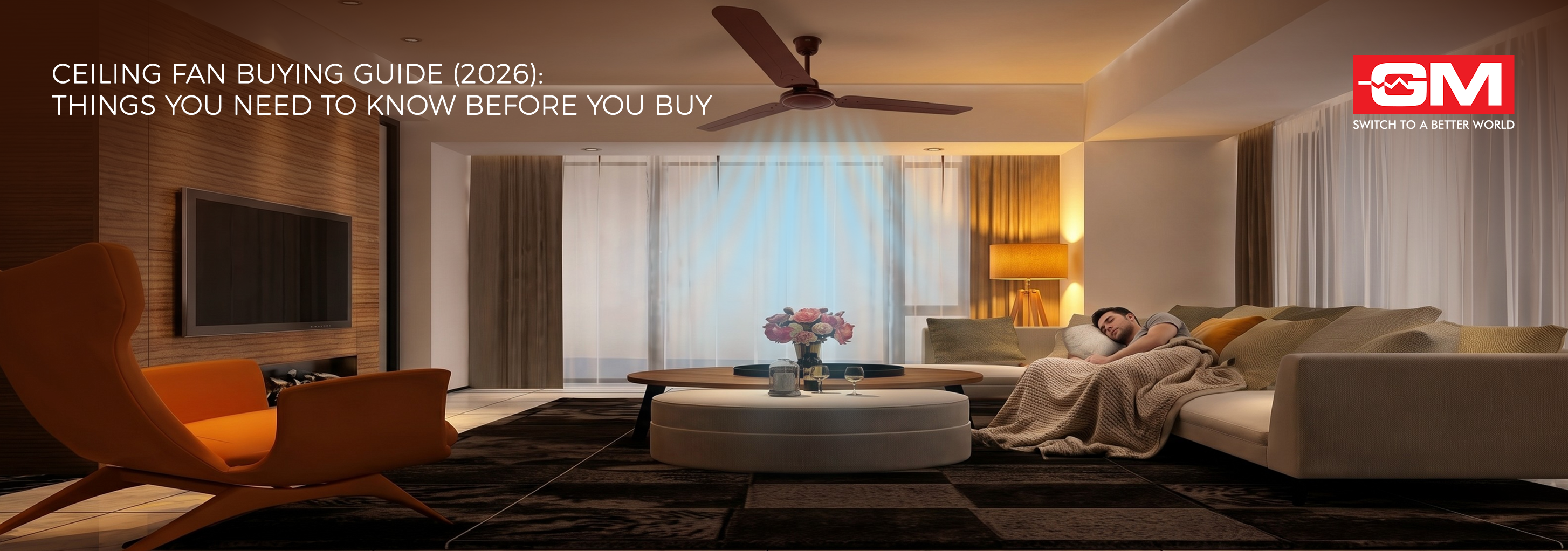
A ceiling fan runs for hours every single day, yet most homeowners choose one in under ten minutes. The result is often a noisy motor overhead, airflow that never quite reaches the corners, a rising electricity bill, and a dated design that quietly works against an otherwise well-finished room. A fan is a long-term fixture, and it deserves a considered decision, one that weighs comfort, running cost, and how the fan looks above your space.
This ceiling fan buying guide cuts through the jargon, from sweep size to BLDC, and gives you a clear, practical framework.
Understanding Space: How to Know What Size Ceiling Fan to Buy
The first step in choosing the right fan is matching it to your room. This is where sweep size matters. Sweep size is the total diameter of the circle created by the fan blades as they spin, measured from one blade tip to the opposite blade tip.
Ceiling height matters too. Low ceilings need a flush-mount (also called a hugger) fan that sits close to the surface, while high ceilings need a downrod to bring the blades to an effective height. Getting this right is one of the most important things to consider when buying a ceiling fan, since an oversized fan in a small room, or an undersized one in a hall, leaves you with uneven cooling and dead spots.
Here is a simple chart on how to know what size ceiling fan to buy:
Motor Technology: What to Look for When Buying a Ceiling Fan
In 2026, the clear shift is towards BLDC (Brushless Direct Current) motors, which operate without physical brushes, making them quieter, more efficient, and longer-lasting than conventional ones. Knowing the difference is central to what to look for when buying a ceiling fan.
The table below shows how a BLDC motor compares with a conventional AC motor:
A BLDC motor is not just quieter; it is cheaper to run, day after day. Consider the GM Modular Excel35 BLDC Ceiling Fan, which draws just 38W against the 70W to 80W of a conventional fan. In a home where the fan runs 10 to 12 hours a day, that gap can deliver up to 50% energy savings, adding up to a noticeably lower bill over a long Indian summer. Its 100% copper winding holds performance steady when the voltage dips, and a pre-lubricated double ball bearing keeps it running smoothly for years with little maintenance.
Air Delivery and Performance Metrics Explained
A common mistake is assuming a higher RPM (rotations per minute) automatically means better cooling. In most cases, that is not true. If the blade pitch (the angle of the blades) is poor, a fast-spinning fan can still move very little air, leaving you with plenty of noise and very little breeze.
The metric that truly matters is CMM (Cubic Metres per Minute), which measures the total volume of air the fan delivers every minute.
Blade count plays a role too. Three blades typically offer higher air delivery and efficiency, which is why they remain popular across India. Four or five blades provide a quieter, gentler breeze. For strong, even airflow, we recommend the GM Modular G-Air High-Speed Fan, which pairs wider-tip aerodynamic blades with 400 RPM and 210 CMM of air delivery, enough to keep a living room comfortable even on a still summer afternoon.
Also Read: A Buyer's Guide to Choosing the Perfect BLDC Fan for Your Home
Smart Features and Aesthetics in Modern Homes
A modern fan should do more than cool a room; it should fit the way you live and the way your home looks
-
Smart controls: A ‘Point Anywhere’ RF remote with a timer lets you adjust speed or switch off from anywhere in the room, without leaving your bed.
-
Anti-dust coatings: Nano-paint finishes can reduce dust accumulation by up to 50%, which means less frequent cleaning and blades that stay presentable for longer.
-
Design finishes: Matte, metallic, and wood-effect options let the fan complement minimalist interiors rather than becoming the one piece that looks out of place overhead.
This is where GM Modular’s range stands out. Its premium ceiling fans combine these smart, low-maintenance features with finishes designed under the FourFive philosophy, an approach built around the four walls of a home and the five human senses. The result is a fan you barely notice while it works, yet quietly appreciate every time you walk into the room.
Why Choose GM Modular Ceiling Fans
Once you know what to look for, the next question is which brand delivers it consistently. GM Modular builds its fans around the strengths that matter most in Indian homes:
-
Real efficiency: BEE 5-star models such as the Excel35 cut running costs by up to 50% compared with conventional fans.
-
Built to last: 100% copper winding and pre-lubricated double ball bearings keep performance stable through voltage swings and years of daily use.
-
Backed by warranty: A 36-month warranty reflects the build quality behind every fan.
-
Designed for the senses: The FourFive philosophy means quiet operation and finishes that suit modern interiors, not just raw airflow.
Ready to see the range? Explore GM Modular ceiling fans and find the model that fits your room.
A Step-by-Step Approach on How to Buy a Ceiling Fan
To bring everything together, here is a practical sequence on how to buy a ceiling fan with confidence:
-
Measure your space. Note your room dimensions and ceiling height first, then use the sweep size chart to shortlist the right fan diameter.
-
Check energy efficiency. Look for a BEE (Bureau of Energy Efficiency) 5-star rating, which indicates the fan meets strong energy-saving standards.
-
Choose your blade count. Decide between three blades for higher airflow or four to five blades for quieter, gentler operation, based on where the fan will be installed.
-
Review warranty and service. Check the warranty period and confirm that reliable after-sales support is available in your area. A well-built ceiling fan should deliver consistent performance for years without wobbling, excess noise, or declining airflow, and a dependable warranty is a fair signal of that build quality.
Safe Installation Practices
A fan is only as good as its installation. Always turn off the main power supply before any work begins. Make sure the ceiling hook is structurally sound and rated to support the full weight of the fan, as a weak mounting point is a genuine safety risk. For secure wiring and mounting, we recommend consulting a licensed electrician.
The right ceiling fan is not just another appliance. It is a long-term investment in comfort, efficiency, and the overall feel of your home, working quietly in the background while elevating every room it lives in. GM Modular fans bring together BEE 5-star efficiency, durable copper-wound BLDC (Brushless Direct Current) motors, and finishes shaped by the FourFive philosophy, so you gain years of calm, economical cooling. Explore the collection today and switch to a better world of cooling.
Frequently Asked Questions
1. What is the most important factor in this ceiling fan buying guide?
Matching the sweep size to your room dimensions is the most important factor. A correctly sized fan delivers even air circulation, while a mismatched one struggles to cool the room however powerful its motor.
2. Are BLDC fans truly worth the initial investment?
Yes, A BLDC motor uses far less electricity. A BEE 5-star model like the GM Modular Excel35 can cut running costs by up to 50%, so the reduced bills typically recover the price difference within a few years.
3. How to know what size ceiling fan to buy for a standard bedroom?
For a standard bedroom between 75 and 144 square feet, a 1200 mm sweep size is typically ideal. It provides balanced air circulation without overwhelming a moderately sized space.
4. What to look for when buying a ceiling fan for a low ceiling?
For a low ceiling, choose a flush-mount or hugger fan. It sits close to the ceiling and keeps a safe operating distance between the blades and anyone standing below.
5. How many blades are best for a home ceiling fan?
It depends on your priority. Three blades are standard across Indian homes for high-speed, efficient airflow.
Related Blogs
Bladeless Fan Buying Guide: 10 Checks | GM Modular
Bladeless Fan Buying Guide: 10 Things to Check Before You Buy A bladeless fan looks like the obvious upgrade. No spinning blades, a slim tower, a quiet hum, and a price that hints it must be the better choice. But the word “bladeless” on
Read More
What Is a GaN Charger? A Simple Guide
What Is a GaN Charger? Everything You Need to Know You have probably used gallium nitride for years without knowing it. Before it reached the charger on your wall, this material lit up the first white LEDs, powered blue lasers, and read the discs in
Read More
GM Artic Air 1: 3-in-1 Bladeless Tower Fan
Why the GM Artic Air 1 Is the Ultimate 3-in-1 Appliance for Every Season Picture one slim tower in the corner of your living room. In May, it cools you through a brutal afternoon. In August, it clears the damp, stale air the monsoon leaves beh
Read More
Wireless Charging vs Wired Charging: Which Is Faster?
Wireless Charging vs Wired Charging: Which Is Faster? If your phone is at 10% and you have twenty minutes before heading out, which charger should you grab: the cable or the pad? Wireless charging is everywhere now, yet most of us still reach for a
Read More