Blog
Flood Light vs Street Light: Key Differences You Should Know
Updated on Dec 2025
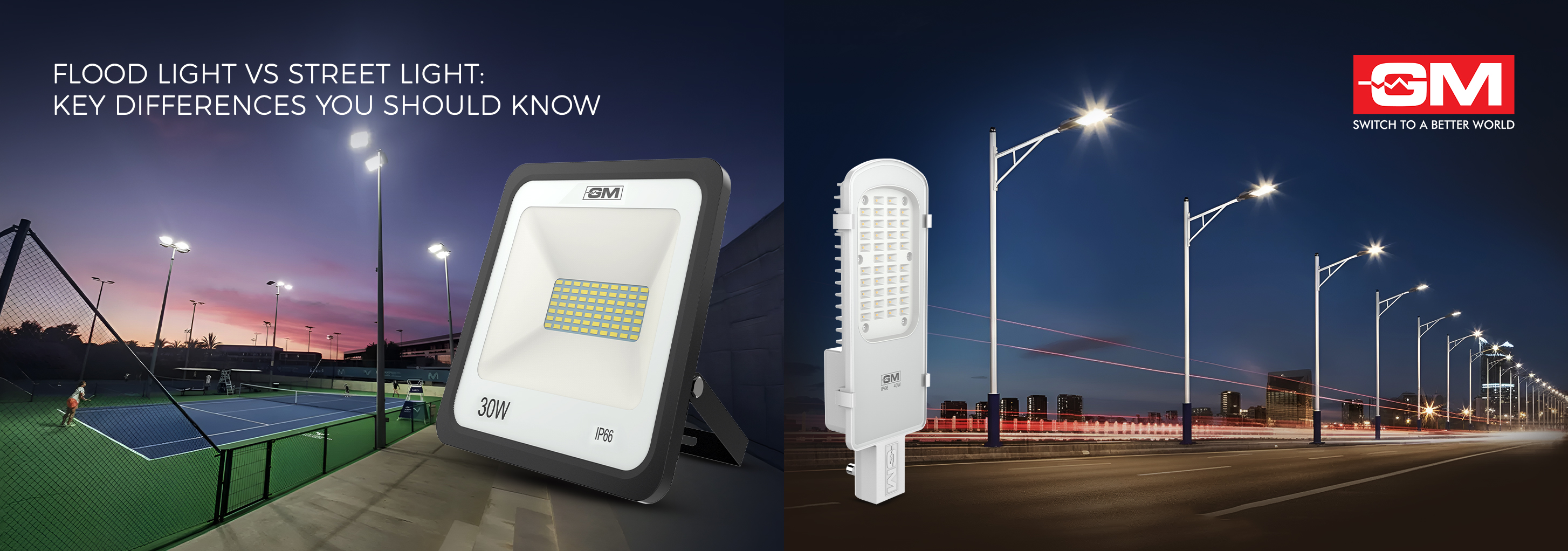
Lighting is crucial for making outdoor spaces safer, more visible, and aesthetically pleasing. Floodlights and streetlights both illuminate large areas, but they differ significantly in terms of their design, beam patterns, and uses. Knowing the difference between flood lights and street lights can help you pick the right light fixture for your project, whether it's for a home, a business, or a city infrastructure.
Understanding the Basics
Before diving into the difference between street light and flood light, it’s important to understand what each lighting type does and where it’s most effective.
What are Floodlights?
Floodlights are high-intensity lights designed to illuminate wide, open spaces. They produce a broad beam angle, generally between 100° and 120°, distributing light uniformly across large areas. These are commonly used in stadiums, parking lots, construction sites, warehouses, and building facades. Their main goal is to ensure maximum brightness and clarity, especially where detailed visibility is needed.
Advancements in LED street-lighting technology have enabled modern LED flood lights to outperform traditional halogen fixtures in both energy efficiency and durability. They offer consistent luminosity, lower maintenance and customisable beam angles for targeted illumination.
To know more, read our detailed blog on What is a Flood Light? Definition, Purpose, and Applications.
What is a Street Light?
A street light, as the name suggests, is designed to illuminate roadways, pathways, and public streets. Street lights typically feature a narrower beam angle (30° to 60°), focusing the light downward to cover a linear stretch along the road. Their uniform beam distribution ensures smooth, glare-free lighting that enhances visibility for drivers and pedestrians with light that stays focused on the intended areas. The shift from conventional sodium vapour lamps to LED street lights has revolutionised urban lighting systems, allowing better energy efficiency, smart controls, and longer lamp life.
Flood Light vs Street Light: A Detailed Comparison
Although the purpose of both the lights is outdoor illumination, the flood light vs street light difference lies in their beam angle, intensity, application, and design. Both serve specific functions and deliver distinct lighting performances suited to their respective environments.
Floodlights are designed to spread light over a wide area, while street lights focus illumination along narrow pathways. The key variations can be observed in how each light type distributes brightness and energy consumption across different outdoor spaces. Here’s a closer look at the main differences between the two:
-
Beam Angle: Floodlights feature a wide beam angle ranging between 100° and 120°, making them ideal for illuminating large open areas. Street lights, on the other hand, have a narrow beam angle of about 30° to 60°, ensuring focused lighting on roads and pathways without wastage.
-
Lighting Coverage: Floodlights are best suited for broad spaces like stadiums, parking lots, and building exteriors where expansive coverage is needed. Street lights are intended for long, narrow stretches such as highways, residential streets, and public walkways.
-
Mounting Height: Floodlights can be mounted at different heights depending on where illumination is required. They may be positioned on poles, walls, or structures. Street lights are usually installed at a standard height along poles, ensuring continuous illumination along roads.
-
Application Areas: Floodlights find use in industrial settings, construction sites, sports arenas, and large commercial spaces. Street lights primarily cater to public infrastructure such as city roads, residential lanes, overpasses, and transportation routes.
-
Design: Floodlights come with adjustable heads that can be tilted or rotated, allowing light to be directed precisely where it’s needed. Street lights usually feature a fixed head design that disperses light uniformly downward.
-
Light Intensity: Floodlights are built to deliver high-intensity brightness suitable for wide coverage and high-activity zones. Street lights provide consistent, moderate illumination that supports safe navigation on roads without glare.
-
Power Consumption: Floodlights generally consume more power due to their wider lighting range and stronger lumen output. Street lights are designed for better energy efficiency, focusing their light only on necessary areas to reduce electricity usage.
Beam Angle and Light Spread
One of the primary factors in determining the difference between a street light and a flood light is the beam angle. Floodlights provide a broader coverage area, casting light across open zones such as gardens, sports arenas, or parking spaces. Their flexibility allows light to be directed at various angles, making them highly versatile.
Street lights, however, focus their light downward in a uniform pattern to illuminate streets and sidewalks without creating glare or light pollution. This targeted approach makes them ideal for public safety and nighttime visibility on roads.
Brightness and Intensity
When comparing flood lights and street lights, brightness is another important factor. Floodlights give off a lot of light that is meant to be clear even from far away. They work best in places where there needs to be bright light without shadows. Street lights are designed to be moderately bright, so they provide consistent light that helps cars and pedestrians safely navigate without being too bright. The main difference between an LED flood light and an LED street light is how many lumens they put out and how well they control the beam.
Design and Mounting
Floodlights come with adjustable heads that can be tilted and rotated to illuminate specific areas. This flexibility allows users to tailor the lighting direction based on their space requirements. For instance, a floodlight installed on a tall pole can be directed toward a sports field or parking area for optimal performance. Street lights feature a more uniform, fixed structure, mounted at consistent intervals along the road. This design ensures continuous light distribution across roadways, preventing dark patches or bright spots.
Power and Energy Efficiency
LED technology is used in both floodlights and street lights these days. This uses a lot less energy than regular lamps. But the way LED flood lights and LED street lights are set up is different. Floodlights use more power because they put out more lumens, but they cover a larger area. Street lights, on the other hand, are made to be as efficient as possible by only lighting up areas where they are needed. An LED floodlight for a sports field might need 150 to 300 watts, but an LED street light that lights up a section of road might only need 60 to 120 watts to do its job well.
Applications and Use Cases
Understanding where to install each type helps in making the right decision between floodlight and streetlight.
-
Flood Light Applications:
Stadiums and sports arenas
Architectural lighting for buildings
Industrial and construction zones
Large parking lots and open fields
-
Street Light Applications:
City roads and highways
Residential and commercial streets
Pathways, parks, and college campuses
Public transportation routes
In terms of street light vs flood light practicality, the selection depends on the illumination objective, wide-area brightness, or directed roadway lighting.
Cost and Maintenance
Though LED technology minimises operational costs, floodlight and street light systems still differ in maintenance and installation. Floodlights, often used in fewer numbers but with higher wattage, might need individual inspection and adjustments for beam alignment. Street lights, typically installed in series along poles, benefit from centralised lighting controls and smart systems that automate performance monitoring. India alone has installed approximately 13.2 million LED streetlights as of mid-2025, significantly reducing carbon emissions and supporting the transition to greener urban infrastructure.
What You Should Remember About Flood Lights and Street Lights
Not only do street lights and floodlights look different, but they also work differently when it comes to lighting. Floodlights are made to work in a lot of different situations and cover a lot of ground, while street lights are made to be safe and work well. It depends on your needs for light, the size of the area, and how you want it to look.
Whether you’re planning to illuminate a sports complex or an entire roadway network, understanding floodlight vs street light differences ensures proper lighting performance, energy savings, and longevity.
Frequently Asked Questions
1. What are floodlights mainly used for?
Floodlights are used to illuminate large open areas such as stadiums, parking lots, or industrial zones where broad and intense lighting is required.
2. What kind of light is used on roads?
Street lights are used on roads. They offer focused, downward illumination ideal for highways and pathways.
3. Are LED floodlights more powerful than LED street lights?
Yes, in general, the LED flood light vs LED street light comparison shows that floodlights have a higher lumen output, making them brighter and suitable for larger spaces.
4. How does the design differ between floodlights and street lights?
Floodlights have adjustable angles for flexible lighting direction, while street lights have fixed angles for consistent road illumination.
5. Which is more energy-efficient: street light or flood light?
Street lights are more energy-efficient for linear spaces like roads, while floodlights are efficient for broad area illumination despite consuming slightly more power.
Related Blogs
Bladeless Fan Buying Guide: 10 Checks | GM Modular
Bladeless Fan Buying Guide: 10 Things to Check Before You Buy A bladeless fan looks like the obvious upgrade. No spinning blades, a slim tower, a quiet hum, and a price that hints it must be the better choice. But the word “bladeless” on
Read More
What Is a GaN Charger? A Simple Guide
What Is a GaN Charger? Everything You Need to Know You have probably used gallium nitride for years without knowing it. Before it reached the charger on your wall, this material lit up the first white LEDs, powered blue lasers, and read the discs in
Read More
GM Artic Air 1: 3-in-1 Bladeless Tower Fan
Why the GM Artic Air 1 Is the Ultimate 3-in-1 Appliance for Every Season Picture one slim tower in the corner of your living room. In May, it cools you through a brutal afternoon. In August, it clears the damp, stale air the monsoon leaves beh
Read More
Wireless Charging vs Wired Charging: Which Is Faster?
Wireless Charging vs Wired Charging: Which Is Faster? If your phone is at 10% and you have twenty minutes before heading out, which charger should you grab: the cable or the pad? Wireless charging is everywhere now, yet most of us still reach for a
Read More